Diamond Grillz UK: Real Diamonds vs Lab vs Moissanite — The Complete Guide
"Diamond grillz" is one of the most searched terms in UK custom jewellery. It's also one of the most misused — sellers use it to describe everything from genuine mined diamonds to lab-grown diamonds to moissanite to cubic zirconia. Understanding the difference is the difference between getting what you want and getting something else entirely.
This guide covers all three legitimate options — natural diamonds, lab diamonds, and moissanite — what they actually are, how they perform in grillz, what they cost, and how to choose between them.
The Three Stones: What They Are
Natural (Mined) Diamonds
Natural diamonds form over millions of years under extreme pressure and heat in the Earth's mantle. They are the hardest naturally occurring substance known (10 on the Mohs scale), and their optical properties — the way they refract and reflect light — are the benchmark against which all other stones are compared.
Natural diamonds are the most expensive option. In grillz, where you may need dozens or hundreds of stones, the cost of natural diamonds at meaningful carat weight is prohibitive for most commissions.
Lab-Grown Diamonds
Lab-grown diamonds are real diamonds — chemically, physically, and optically identical to mined stones. They are produced using either HPHT (High Pressure High Temperature) or CVD (Chemical Vapour Deposition) processes that replicate the conditions under which natural diamonds form, but in days or weeks rather than millions of years.
A lab diamond cannot be distinguished from a mined diamond by visual inspection or most standard gemological tests. They are graded using the same 4Cs system (cut, colour, clarity, carat) and certified by the same bodies (GIA, IGI). They are real diamonds.
Lab diamonds typically cost 60–80% less than comparable natural stones.
For a dedicated guide, see our lab diamond grillz article.
Moissanite
Moissanite is not a diamond — it's a distinct gemstone, silicon carbide (SiC). It was first discovered in a meteor crater in 1893. Natural moissanite is extraordinarily rare; virtually all moissanite used in jewellery today is laboratory-grown.
Moissanite has different optical properties from diamond: a higher refractive index (2.65–2.69 vs 2.42 for diamond) and higher fire dispersion. In practical terms, moissanite produces more rainbow sparkle — more colour scatter — than diamond. Some people prefer this; others want the classic white flash of diamond.
Moissanite is not cubic zirconia. CZ is a synthetic glass-like material with no gemological status. Moissanite is a real gemstone with consistent, permanent optical properties. See our moissanite grillz guide and real vs fake grillz guide.
Head-to-Head Comparison
| Natural Diamond | Lab Diamond | Moissanite | |
|---|---|---|---|
| What it is | Mined diamond | Real diamond, lab-grown | Silicon carbide gemstone |
| Chemical formula | Carbon (C) | Carbon (C) | Silicon carbide (SiC) |
| Hardness | 10 Mohs | 10 Mohs | 9.25 Mohs |
| Refractive index | 2.42 | 2.42 | 2.65–2.69 |
| Brilliance | Classic white flash | Classic white flash | Rainbow fire/scatter |
| VVS clarity available | Yes | Yes | Yes |
| Ethical | Varies | ✓ No mining | ✓ No mining |
| Price (relative) | Highest | Mid | Lower |
| Detectable from natural diamond | N/A | Only with specialist equipment | Yes — different optical signature |
| Used at Ice Jeweller | By special request | ✓ Yes | ✓ Yes |
The Look: What's the Visual Difference?
Natural diamond and lab diamond produce identical visual output — the same optical signature, the same white brilliance, the same fire pattern. No visual difference exists between natural and lab diamond.
Moissanite vs diamond does produce a visible difference to a trained eye. Moissanite's higher refractive index creates a "disco ball" effect — more colour scatter, more rainbow dispersion. Some people specifically want this; others want the more restrained white flash of diamond. Neither is objectively better — it's a preference.
In a fully iced grillz piece with hundreds of stones, the cumulative visual effect is different:
- Diamond (natural or lab): Dense, white, cold. Each stone flashes white. The overall effect is a sheet of white light.
- Moissanite: Dense, fiery, coloured. Each stone produces rainbow scatter. The overall effect is a field of moving, coloured light — particularly dramatic under direct lighting.
In Grillz Specifically — What Matters Most
Hardness: For grillz that will be worn and removed regularly, stone hardness matters. Both diamond (10 Mohs) and moissanite (9.25 Mohs) are hard enough to resist scratching in normal wear conditions. The difference is minimal for most users.
Setting security: Stones at the size used in grillz (typically 1–2mm) are secured by the setting, not by their hardness. A well-set VVS moissanite is as secure as a well-set lab diamond of the same size.
Size consistency: For snow-setting and bustdown work, perfect size consistency across hundreds of stones is critical. Both lab diamonds and moissanite are available in tightly matched sizes at VVS clarity. See our snow set grillz guide for why this matters technically.
Cost: For a full iced set — potentially 200–400+ stones — the cost difference between moissanite and lab diamond is significant. Moissanite allows a fully iced piece at a price point where lab diamond would be substantially more. Natural diamond in a full iced set is priced accordingly.
VVS Clarity — Does It Apply to All Three?
Yes. VVS (Very Very Slightly Included) is a GIA clarity grade that describes inclusions visible only under 10x magnification. It applies to diamond (natural and lab) on the GIA grading scale. Moissanite is graded using equivalent clarity terminology by moissanite certification bodies.
In practice: VVS moissanite, VVS lab diamond, and VVS natural diamond all look clean to the naked eye. The difference in visible clarity between VVS and higher grades (VS, SI) is undetectable without magnification.
See our VVS grillz guide for a full explanation of what VVS means and why it matters for iced grillz.
Which Metal Works Best with Diamond Grillz?
White gold amplifies the cold brilliance of diamonds and the white-fire aesthetic. The metal disappears behind the stones and the overall effect is pure light. See our white gold grillz guide.
Yellow gold creates the classic iced look — warm metal contrasted with cold stones. For moissanite, the warm/cool contrast is heightened by the rainbow scatter. For diamond, the contrast is more formal — the look most associated with luxury jewellery history.
Rose gold with diamonds produces a distinctive warm/cold effect with high editorial appeal.
How Much Do Diamond Grillz Cost in the UK?
| Type | Single Tooth (from) | Full Row (from) |
|---|---|---|
| VVS Moissanite | £120 (silver), £186 (gold) | from £600+ |
| VVS Lab Diamond | from £250 (gold) | from £1,000+ |
| Natural Diamond | POA — contact us | POA |
These are indicative starting points. Actual pricing depends on tooth count, metal, stone size, setting density, and coverage style. For a full cost breakdown, see our grillz cost guide. For a quote on a diamond commission, contact us directly.
Frequently Asked Questions
Are diamond grillz made with real diamonds? It depends on the seller. "Diamond grillz" can mean natural diamonds, lab-grown diamonds, or sometimes moissanite. At Ice Jeweller, we use VVS moissanite and VVS lab-grown diamonds — both are real stones. We do not use cubic zirconia. If a seller can't tell you exactly what stone type they use, that's an answer.
Are lab diamonds real diamonds? Yes. Lab-grown diamonds are chemically, physically, and optically identical to mined diamonds. They are diamonds — not simulants, not imitations. See our lab diamond grillz guide.
Is moissanite a diamond? No — moissanite is a distinct gemstone (silicon carbide) with different chemical composition. It looks similar to diamond but has different optical properties — notably more rainbow fire. It is not a diamond but it is a real gemstone.
Which produces better grillz — diamond or moissanite? Neither is objectively better. Diamond produces classic white brilliance; moissanite produces more rainbow scatter. The choice depends on what visual effect you want. Both are VVS clarity. Both are real stones. Both perform excellently in grillz.
Can I get natural diamond grillz? Yes — by special request. Natural diamond grillz are significantly more expensive than lab diamond equivalents for no visible difference. For most grillz commissions, lab diamond delivers identical appearance at much lower cost. Contact us to discuss natural diamond options.
How do I know if my grillz have real stones? Ask the maker explicitly — stone type (moissanite, lab diamond, natural diamond), clarity grade, and certification. A legitimate custom maker will tell you exactly. See our real vs fake grillz guide for how to assess stone quality.
Order Your Diamond Grillz
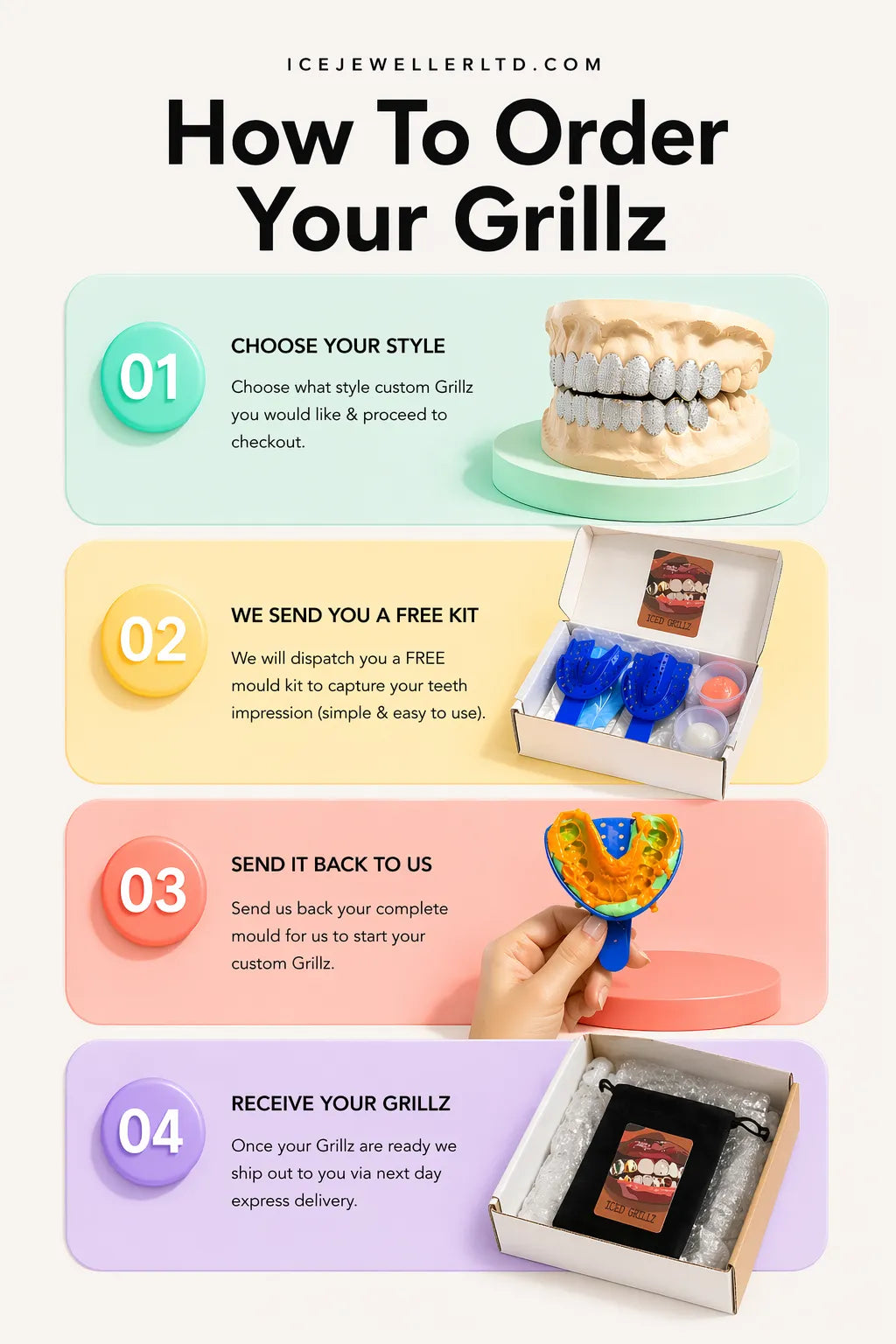
Every Ice Jeweller stone-set piece is hand-set by Padra using VVS moissanite or VVS lab-grown diamonds in solid gold or silver — made from your dental impression, with a CAD preview before production.
- Shop All Grillz →
- Get Your Free Impression Kit →
- VVS Grillz Guide →
- Moissanite Grillz Guide →
- Lab Diamond Grillz Guide →
- Contact Us on WhatsApp →