Snow Set Grillz: What It Is & Why It's the Hardest Technique
Most stone-set grillz are beautiful. Snow-set grillz are different. When done properly, the entire surface of the piece becomes stone — no metal visible, no gaps, no interruptions. Just an unbroken field of light. It's called snow setting because at VVS clarity, the surface looks exactly like packed snow: dense, white, brilliant, continuous.
It is also extraordinarily difficult to do. Which is why so few makers offer it and why most pieces marketed as snow-set don't look the way they should.
What Is Snow Setting?
Snow setting (also called pavé à grain or micro-pavé in fine jewellery) is a stone-setting technique where small stones are set so close together that the beads of metal holding them in place are barely visible. In traditional fine jewellery, there are tiny gaps between stones. In true snow setting, the stones are touching — there is no visible gap, no visible metal, just stone surface.
Applied to grillz, this means:
- Every millimetre of the tooth cap surface is covered in stone
- The stones are sized and positioned so they sit flush and touching
- The metal setting becomes invisible beneath the stone layer
- The result is a single, continuous, seamless surface of sparkle
This is the most technically demanding grillz technique that exists.
How Is It Different from Bustdown?
These terms are often used interchangeably but they're not the same:
| Bustdown | Snow Set | |
|---|---|---|
| Stone coverage | Full surface, stones across all faces | Full surface, stones touching — no gaps |
| Metal visibility | Thin metal lines/prongs visible between stones | Metal invisible — stones hide it completely |
| Stone size | Mix of sizes possible | Very small, consistent stones required |
| Technical difficulty | High | Extreme |
| Light effect | Dense sparkle | Continuous seamless field of light |
| Visual from distance | Stone-covered | Appears to be a single stone surface |
Bustdown is fully iced. Snow-set takes that further — the metal disappears entirely. See our bustdown grillz guide for more on bustdown specifically, and our iced out grillz guide for the full spectrum of iced styles.
Why Is Snow Setting So Rare?
Stone consistency. Snow setting requires stones that are not just VVS clarity but also perfectly cut and matched in size. Even slight variation in stone dimensions creates visible gaps or uneven surfaces once the stones are packed together. Sourcing and grading hundreds of perfectly matched micro-stones is time-consuming and costly.
Technical precision. Each stone must be positioned and set individually. In snow setting, the setter must create tiny metal beads between each stone while maintaining perfect stone alignment. A single misplaced stone disrupts the visual effect of the entire section. There is no tool for this — it's done by hand, under magnification, with instruments measured in fractions of a millimetre.
Years of practice. Snow setting on curved surfaces — like teeth — is harder than on flat surfaces. The curvature of a tooth cap means every stone is set at a slightly different angle. The setter must compensate for this continuously while maintaining the seamless appearance.
Padra has been doing this for fifteen years. Snow setting is Ice Jeweller's signature technique because most makers simply don't have the skill or patience to execute it properly.
What Stones Are Used for Snow Setting?
VVS Moissanite — the most popular choice for snow-set grillz. Moissanite has a higher refractive index than diamond, meaning it produces more rainbow fire and scatter per stone. In a snow-set piece, this compounds across hundreds of stones simultaneously — the result is extraordinary under any light. See our moissanite grillz guide and VVS grillz guide.
VVS Lab-Grown Diamonds — produce the classic white brilliance of diamonds in a snow-set piece. Less rainbow fire than moissanite, more of a cold, white flash. See our lab diamond grillz guide.
We do not use cubic zirconia in snow-set pieces. CZ is too inconsistent in cut and prone to cloudiness over time — both problems that are amplified when hundreds of stones are packed together. See our real vs fake grillz guide.
What Metal Works Best for Snow Set Grillz?
White gold is the most common choice for snow setting. The cool silver-white tone of white gold beneath VVS moissanite or lab diamond produces the coldest, most ice-like result. The metal disappears and the stones take over entirely. See our white gold grillz guide.
Yellow gold creates a warm base that contrasts dramatically with cold stones. When the metal is visible in a bustdown piece, this contrast defines the look. In a snow-set piece where the metal disappears, the yellow gold is only visible at the edges and interior — producing a framed effect.
Sterling silver — produces a bright, high-contrast base that maximises the visual impact of the stones. The most accessible entry point for snow-setting work. See our silver grillz guide for detail.
Snow Set Grillz Styles
Full snow-set top set — all top teeth snow-set. The most visible placement for this technique — every angle of your top row reads as an unbroken stone surface.
Full snow-set bottom set — bottom row snow-set. Dramatic when you speak or smile, more understated at rest.
Full top + bottom snow-set — the complete statement. The most technically involved commission we take.
Single snow-set tooth — one tooth, fully snow-set. Entry point for this technique. Striking as a solo statement piece.
How Long Do Snow Set Grillz Take?
Snow-set pieces take longer than standard grillz due to the hand-setting work involved. Where a solid gold piece might take 3–4 weeks from impression to delivery, a full snow-set set typically takes 4–6 weeks. The stone selection and setting work alone can take several days per piece.
For a full breakdown of the timeline from impression to delivery, see our how long does it take guide.
How Much Do Snow Set Grillz Cost?
Snow setting is the most labour-intensive technique we offer. Pricing reflects the stone sourcing, selection, and the time required for the setting work itself.
| Style | From |
|---|---|
| Single tooth, snow-set (gold, moissanite) | from £250+ |
| Partial row snow-set (gold) | from £500+ |
| Full top or bottom, snow-set (gold) | POA |
| Full top + bottom snow-set | POA |
For full pricing across all styles, see our grillz cost guide. For a specific quote on a snow-set commission, contact us directly on WhatsApp.
Frequently Asked Questions
What is snow setting in grillz? Snow setting is a stone-setting technique where individual stones are set so close together they touch — no metal is visible between them. The entire surface becomes an unbroken field of stone. It produces a seamless, continuous sparkle effect rather than discrete individual stones.
Is snow setting the same as bustdown? No. Bustdown means the full surface is covered with stones but metal is still visible between them. Snow setting takes this further — stones are packed touching each other so the metal disappears entirely. Snow setting is significantly more technically demanding.
How can I tell if grillz are actually snow-set? Genuinely snow-set grillz have no visible gaps between stones from any angle. The surface reads as a continuous stone layer. If you can see metal or gaps between stones, it's a bustdown piece (still excellent) but not snow-set.
Why is snow setting more expensive? The stone sourcing, stone-by-stone selection for size consistency, and the time-intensive hand-setting work all contribute. A full snow-set piece might take Padra several days of continuous setting work.
Can I order snow set grillz in silver? Yes — silver is a valid base for snow-setting. The stones and the technique are identical; only the base metal changes. See our gold vs silver grillz guide for the comparison.
Commission Your Snow Set Grillz
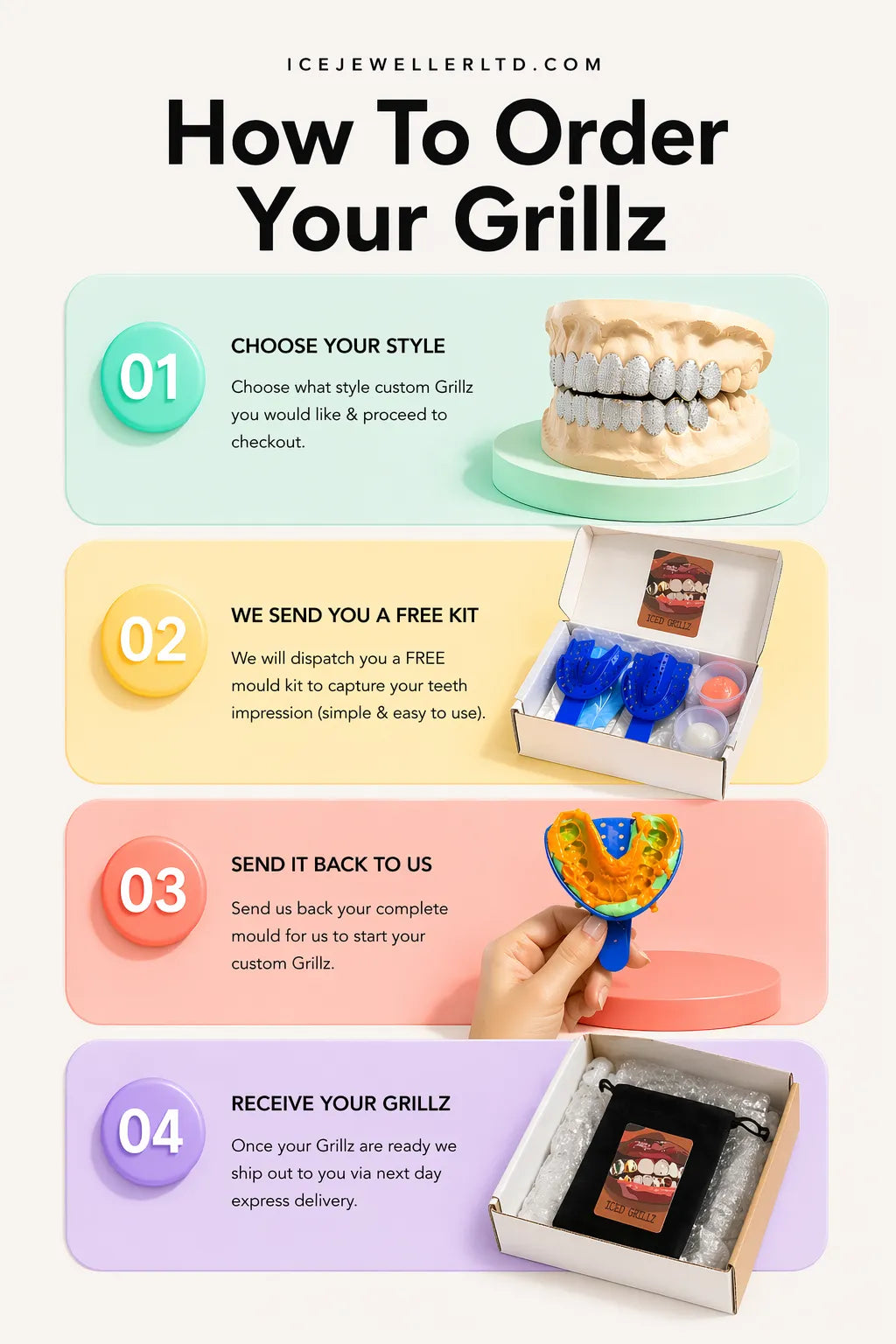
Snow-set grillz are Padra's speciality — fifteen years in the making. Every snow-set piece starts from your dental impression, is previewed in CAD, and hand-set stone by stone.
- Shop All Grillz →
- Get Your Free Impression Kit →
- Bustdown Grillz Guide →
- VVS Grillz Guide →
- Contact Us on WhatsApp →